




Hardenbergh named Medical Director of Shaw Cancer Center
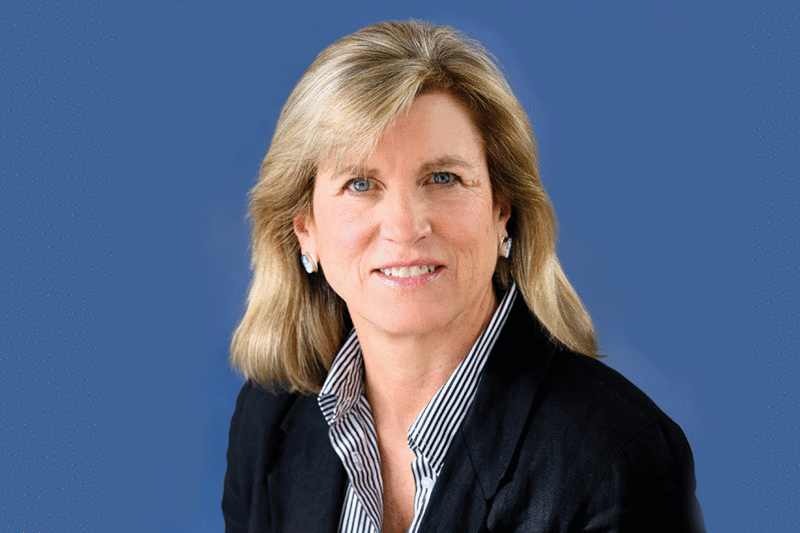
VAIL, CO (July 9, 2020) – Vail Health and Shaw Cancer Center announced that Dr. Patricia Hardenbergh has been named Medical Director of Shaw Cancer Center. In her new role, Dr. Hardenbergh will provide further leadership to Shaw Cancer Center both programmatically and strategically, and will oversee the radiation program, survivorship program, clinical research, the breast care program directed by Dr. Julie Barone, and the breast imaging program directed by Dr. Monique Fox.
“During her almost 20 years at Shaw Cancer Center, Dr. Hardenbergh has made countless contributions that have shaped the lives of many in our community and has improved Shaw’s programming and patient care,” said Stacy Toyama, Vice President of Shaw Cancer Center. “We are excited for Dr. Hardenbergh to take on this new role and continue making invaluable contributions to Shaw.”
Dr. Hardenbergh was a visionary of Jack’s Place, a cancer caring house for Shaw patients to stay during their cancer treatments. She initiated and developed the Spirit of Survival program, which has grown to be an integral part of Shaw’s survival statistics, which are higher than the national average. Dr. Hardenbergh co-led Shaw’s Cancer Committee with Dr. Alexander Urquhart to achieve the Outstanding Achievement Award from the Commission on Cancer earlier in 2020.
On the national level, Dr. Hardenbergh has authored more than 45 publications in peer-reviewed journals, and has been an invited speaker on the national and international stage on multiple occasions. In 2010, Dr. Hardenbergh was the recipient of a $1.35 million grant from the American Society of Clinical Oncology (ASCO) Foundation Improving Cancer Care Grant, funded by Susan G Komen for the Cure. In 2017, she was awarded the American Society of Therapeutic Radiation Oncology (ASTRO) Fellow for her contributions to education and improving cancer care. Dr. Hardenbergh has been an examiner for the American Board of Radiology for more than 10 years, and in 2017 she became a Trustee of the American Board of Radiology.
About Vail Health
Vail Health is a nonprofit community health care system with 12 locations across Eagle and Summit counties. Vail Health offers a 56-bed hospital, 24/7 emergency care, helipad, urgent care clinics, cancer care, breast centers, cardiovascular services, surgery, childbirth, physical therapy, internal medicine, endocrinology and more. Locally operated and governed by a volunteer board of directors, Vail Health has committed $60 million during the next ten years to Eagle Valley Behavioral Health. For more information, visit www.vailhealth.org.