


News
Hot, Cold and Mental Health: Inside Vail Health’s CHILL’D Research Study
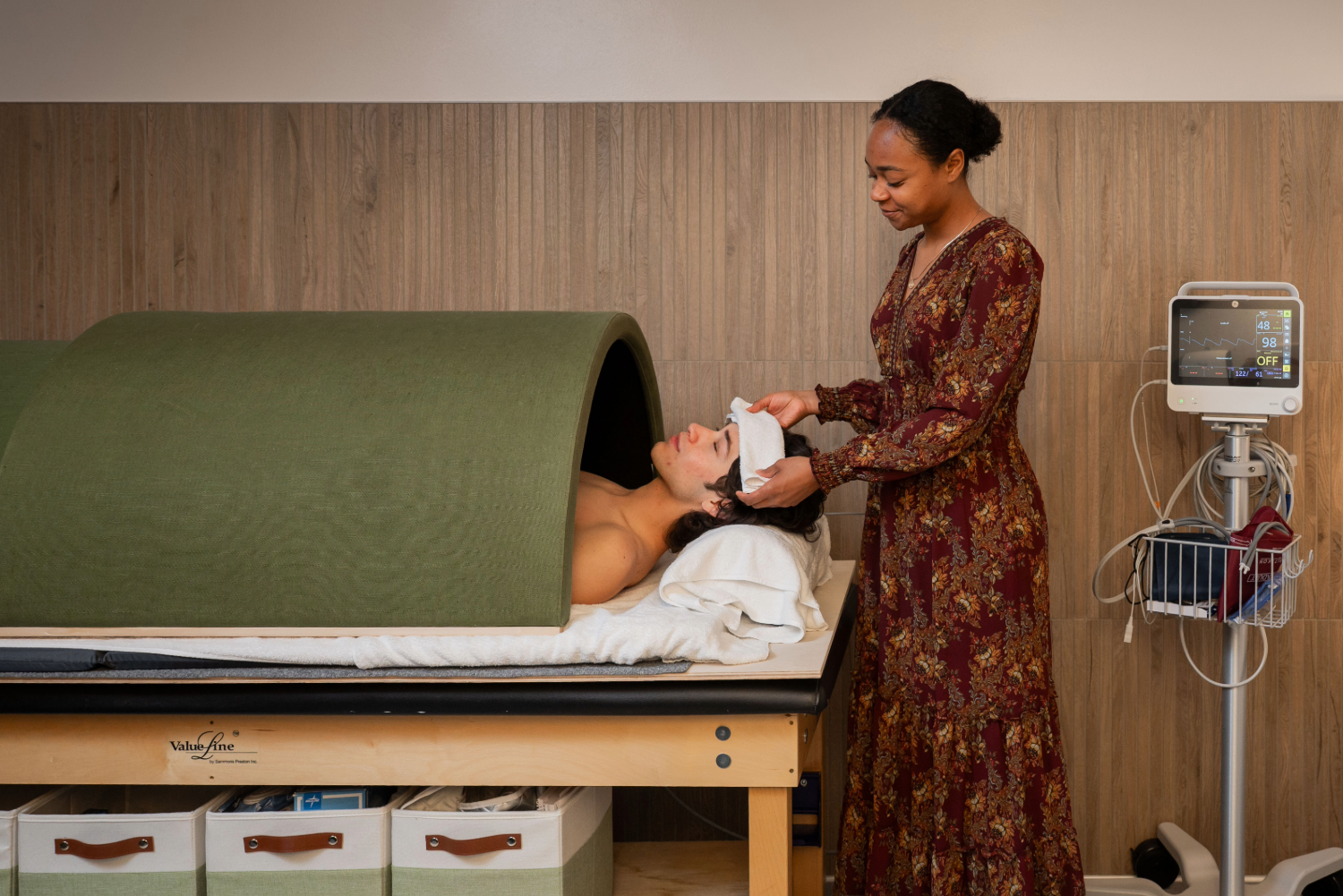
Depression, a mental illness affecting more than 18% of American adults, has no blood marker or single biological cause. It looks and feels different in everyone because the brain is a complex organ, and there is no single way that depression develops. Like many mental health conditions, depression can be treated through medical, pharmaceutical and alternative approaches. One promising avenue under study at Vail Health’s Behavioral Health Innovation Center is contrast therapy, combining sauna and cold plunge treatments.
The Treatment Experience
The ongoing CHILL’D research study takes place at the Wiegers Clinic in Edwards. It is an inspiring and exciting way to contribute to valuable mental health treatment advancements in the Vail Valley.This study has two primary goals. The first is to determine whether adding cold plunge therapy enhances the hyperthermic benefits of sauna use. Hyperthermia, an elevated core body temperature achieved through thermal therapy such as a sauna, has been associated with non-medication depression support. The second goal is to better understand how heat and cold-water exposure affect individuals who are taking antidepressants.
Participants, who may or may not be currently experiencing depression, complete four visits: one screening visit to determine eligibility, one treatment visit and two follow-up visits. On the day of treatment and during subsequent visits, participants have their blood drawn and complete a questionnaire assessing their mental health state of being. Every participant experiences the sauna treatment, and only half of the participants receive the cold plunge therapy.
This is not your typical sauna you see in a gym or spa. Picture a dome omitting infrared heat, where your head is out of the treatment. Upon lying down, the treatment begins at room temperature. Ideally, the participant stays in the sauna until their body temperature gets to 101.3 degrees Fahrenheit. This typically takes about 90 minutes. There is always a Vail Health staff member monitoring and making sure the participant is comfortable and safe.
After the sauna treatment, participants will find out if they have been selected to also go in the cold plunge, where the temperature is 55 degrees Fahrenheit. Participants are randomly assigned to either receive only the sauna treatment, or the sauna treatment followed by a cold plunge. This timing is intentional, explains clinical research supervisor Chloe Sorensen. By waiting until the final moment to reveal who will immerse themselves in the cold water, researchers are able to preserve the study’s blinding for as long as possible, strengthening the study’s scientific rigor. This is a way to control hope and expectancy. Those who have been selected will be asked to stay in the cold plunge for at least two minutes with a maximum of 10 minutes. Each participant returns to the Wiegers Clinic for two follow-up visits, a couple weeks apart, for the blood tests and questionnaires.
Past Research, Future Discoveries
Prior and ongoing research suggests that hyperthermia leads to elevated well-being and decreased depression systems. Hyperthermia causes the activation of the immune system. “We think hyperthermia closely mimics exercise, physiologically and physically,” says Dr. Charles Raison, director of Vail Health Behavioral Health Innovation Center. “It’s a lot like having a session of powerful exercise that causes the body and the brain afterwards to come back stronger.”Raison adds that there is influential research from Scandinavia suggesting that the men who did sauna regularly were much less likely to die of heart attacks, strokes and dementia over a 30-year period. What has yet to be studied is the addition to the cold plunge following the sauna session. The CHILL’D study is discovering what treatment works better for depression. Solely the sauna? Or the sauna preceding the cold plunge?
Additionally, Raison contributed to a small hyperthermia study in Switzerland where the people who were on chronic antidepressants got zero benefit from the heat. Raison explains that a distinctive aspect of the CHILL’D study is that it includes both participants who are on stable doses of antidepressants and those who are not on any medication.
“We are kind of hoping it doesn’t matter [whether you are on or off antidepressants] because then you could stay on your Prozac or your Paxil and you’re going to get as much benefit from the heat,” Raison says.
Inflammation and Depression
Depression can be conceptualized as a disease of premature aging. The blood tests conducted by the CHILL’D study allow Raison and his fellow researchers to examine chemicals associated with inflammation and aging tissue damage. Inflammation is biologically complex and is the body’s first response to tissue damage or an infection.“Many of the physical blood abnormalities that are seen in people, not all but many people, with depression are the same chemicals that promote aging,” Raison shares. “Clinical depression is associated with a shorter lifespan by a number of years. The more severe the mental illness, the shorter the lifespan.”
Raison uses influenza as an example of inflammation.
“The body’s response [to the flu] is inflammation. All of these [flu] molecules get released into the body, they get released by immune cells and the immune cells go up to the brain. In the brain, they give you a fever, they make you tired, they make you want to sleep more. You don’t have energy, you lose interest in doing stuff.”
These are very similar depression symptoms because inflammation is the common denominator.
Many strategies, such as hyperthermia, that help reduce depression also target the same inflammatory processes that contribute to aging and tissue damage. That is why the CHILL’D study includes blood tests: to track how the sauna and cold plunge treatments influence inflammation and other biological markers linked to both mental health and aging.
A Holistic Approach
The CHILL’D study offers an opportunity for participants to explore a treatment in the context of a clinical trial that is both accessible and potentially effective. “A lot of people do not find relief with traditional psychopharmacology, or they do have relief but have side effects that are undesirable,” Sorensen says. “So, in recent years people have had an interest in alternative treatments. Often times, many of the depressed participants have tried other treatments.”Depression can often feel daunting and endless. The same goes for its treatments. But the CHILL’D study offers an approach that you can implement into your daily life in a way that you cannot do with many other treatments. Although the study is still ongoing, most participants leave feeling better than when they walked in. These effects can last for up to a couple weeks.
“We found that the hotter people got, the more their depression improved,” Raison says. “Even a little heat was better than nothing … If you have access to a sauna, getting as hot as safely possible is still beneficial.”
The Vail Health Behavioral Health Innovation Center and the CHILL'D study are possible thanks to generous support from Vail Health Foundation benefactors.
Are You Eligible to Join the Study?
- You may or may not be currently experiencing depression.
- Are you medically healthy?
- Are you between the ages of 18- 65?
- Can you commit to attending four study visits over a four-to-six-week period in Edwards, Colorado? You can receive up to $200 for your participation.
- Do you feel called to contribute to non-medication depression support and research?
More News
-
New!
More

What to Expect Before, During and After a Colonoscopy
If you've been putting off a colonoscopy, you're not alone. It's one of the most recommended — and most avoided — preventive screenings in medicine. But here's what most people don't realize until after their first one: the procedure itself is a non-event. You're asleep. You don't feel a thing. What people actually dread, and what they talk about afterward, is the prep. The good news is that even the prep is manageable, and the payoff is enormous. Colorectal cancer is one of the most preventable cancers when caught early. A colonoscopy doesn't just detect it; in many cases, it stops cancer before it starts.
-
New!
More

Navigating Men’s Sexual Health: Erectile Dysfunction and the Bigger Picture
For something so common — and treatable — erectile dysfunction (ED) is still surprisingly difficult to talk about. “The biggest misconception men have is that there’s a mechanical or physical problem with them, and that’s usually not the case,” explains Dr. Joseph Dall’Era, a urologist at Vail Health. In reality, ED is far more nuanced and manageable than people realize. Understanding what’s happening and knowing when to speak up can shift the experience.
-
New!
More

AI in the Exam Room: What Patients Should Know About Artificial Intelligence in Healthcare
When you walk into a medical appointment today, you might notice something different. Your doctor is looking at you more and less at their computer. They speak through their findings, and you walk away with greater clarity. The result? You feel seen and heard. That’s because providers are implementing a new artificial intelligence technology that captures their conversations. If it sounds scary, it shouldn’t. At Vail Health, AI isn’t replacing physicians or making medical decisions. Instead, it’s working behind the scenes to support providers so they can focus on what matters most: the patient.