


News
Rethinking Resolutions: How to Embrace Real Change in 2026

Every new year marks a rare, universal pause. Each December 31 and January 1, people of all religions, cultures, ethnicities and backgrounds collectively reprieve, reflect and reset. This special time offers natural, reoccurring moments in the human experience to look back on the past year and evaluate desired achievements in the year ahead, commonly known as New Year’s resolutions.
How to Create Meaningful New Year’s Resolutions and Find Success
According to behavioral health professionals at Vail Health, roughly 80% of New Year’s resolutions fail. Clinical psychologist Katie McChesney; licensed social worker Amanda Parsons; and bilingual, bicultural licensed professional counselor Juan Carlos Hernandez Barraza all note that weight loss and gym memberships are among the most common New Year’s resolutions.McChesney, who specializes in acceptance and commitment therapy, says success begins with identifying “your why” — the values that guide you. “A valued domain is an area we identify as a virtue, moral, or sense of purpose,” she explains. “These we tend to learn early in life. They keep us grounded, rarely shift, and they help give each of us a sense of purpose, zest, reasons for living - even when life is at its worst. They serve much like a compass in that they give us direction at times when we feel lost.”
Values can include family, faith, health, love, financial stability, adventure and friendship. A New Year’s resolution is a way to put a value into motion. Success comes when your efforts align with that value. Values themselves aren’t measurable, but they fuel meaningful change.
Parsons adds that resolutions grounded in personal values are more motivating and sustainable. “People get stuck when goals feel unrealistic or disconnected from how they live,” she says.
Hernandez Barraza emphasizes the importance of action: “We can sit here and think, but action is where you connect mind and body. That is when you get dopamine, endorphins, consistency and momentum.”
McChesney underscores the importance of identifying your “why.” She is looking for something that aligns with a value, rather than a goal driven by material gain or external pressure. “If someone wants to lose weight to fit into a dress, that is not a value,” she says. “If that person wants to fit into a social situation and be perceived a certain way, a New Year’s resolution would have something to do with feeling more yourself.”
Achieving a goal still requires discipline. Research on neuroplasticity shows that every step toward a resolution strengthens your brain, creating new pathways and habits. Living in line with your values also reduces depression and anxiety by minimizing cognitive dissonance, McChesney notes.
Resolutions aren’t an “all or nothing” game. Parsons encourages small, attainable goals to build momentum and create lasting change. “Big shifts happen one step at a time. Anyone can be ready for a big shift, they just have to take the first step.”
Try repeating these affirmations to yourself as you embark on your New Year’s resolutions:
- “Every small step counts.”
- “Today is another opportunity to start.”
The Keep, Stop, Start Framework
The professionals at Vail Health argue that the most successful New Year’s resolutions are not blanket statements. Rather, the reflection and goal-setting stem from the “Keep, Start, Stop” framework. Use the tools below to incorporate your values into the steps towards a successful New Year’s resolution.Keep: What is working well for you and how can you keep doing it?
Tool: Backpack MetaphorHernandez Barraza recommends reflecting on what has served you in the past year and carrying those lessons with you into the proceeding calendar year. Find a piece of paper and something to write with. Draw an outline of a backpack and fill it with the habits, traits and people you want to bring with you. You can also use a real backpack and place objects inside that symbolize what you wish to keep with you in the coming year.
Stop: Identify what isn’t working and why.
Tool: Letter WritingTake a moment to validate and honor your experiences from the past year. With pen and paper in hand, write freely to yourself. Let your thoughts flow without judgement.
Use this prompt to guide you: Reflect on the year 2025. What are you grateful for, and what are you ready to leave behind?
Start: Use what you learned from “stop” and reflect on what might work better instead.
Tool: Vision BoardVisualize what you want for yourself in 2026. Gather magazines, recycled print materials or any images that inspire you. Using scissors, glue and construction paper, get creative and assemble a collage. Place yourself at the center and intentionally surround your image with words and visuals that represent how you want the year ahead to unfold. You can also make your vision board digitally on a computer or tablet.
“Often times, there is a struggle to quantify and verbalize a goal, but once you externalize it and see the bigger image, you can see the dynamics of the experience,” Hernandez Barraza says. “If you do not see yourself reflected in the goal, then you are less likely to follow the goal.”
The New Year’s Resolutions Guiding Vail Health Experts in 2026
Just like the rest of society, Vail Health experts are entering 2026 with goal-setting for lasting change. Using the “Keep, Start, Stop” framework, here are their New Year’s resolutions for 2026.Katie McChesney, MA, PsyD
- Consistently practice work-life balance. Add more self-care and recreation into life, rather than over-working myself.
- Schedule and book international travel.
- Eat more protein to improve and keep muscle as a perimenopausal woman.
Licensed social worker Amanda Parsons
- Keep learning. Proactively sign up for trainings that interest me and expand my skills.
- Practice yoga and mindfulness three days a week.
- Stop saying “yes” to commitments when I want to say no because I do not have the time, energy or desire.
Bilingual and bicultural licensed social worker Juan Carlos Hernandez Barraza
- Improve mobility. I have had two knee surgeries these past years. I want to improve my strength and mobility in these joints and my whole body to reconnect with the environment through recreational activities.
- Continue to invest in relationships with purpose: friends, family, coworkers and community members.
- Professional development. I want to prioritize additional development in more trainings and leadership.
More News
-
New!
More
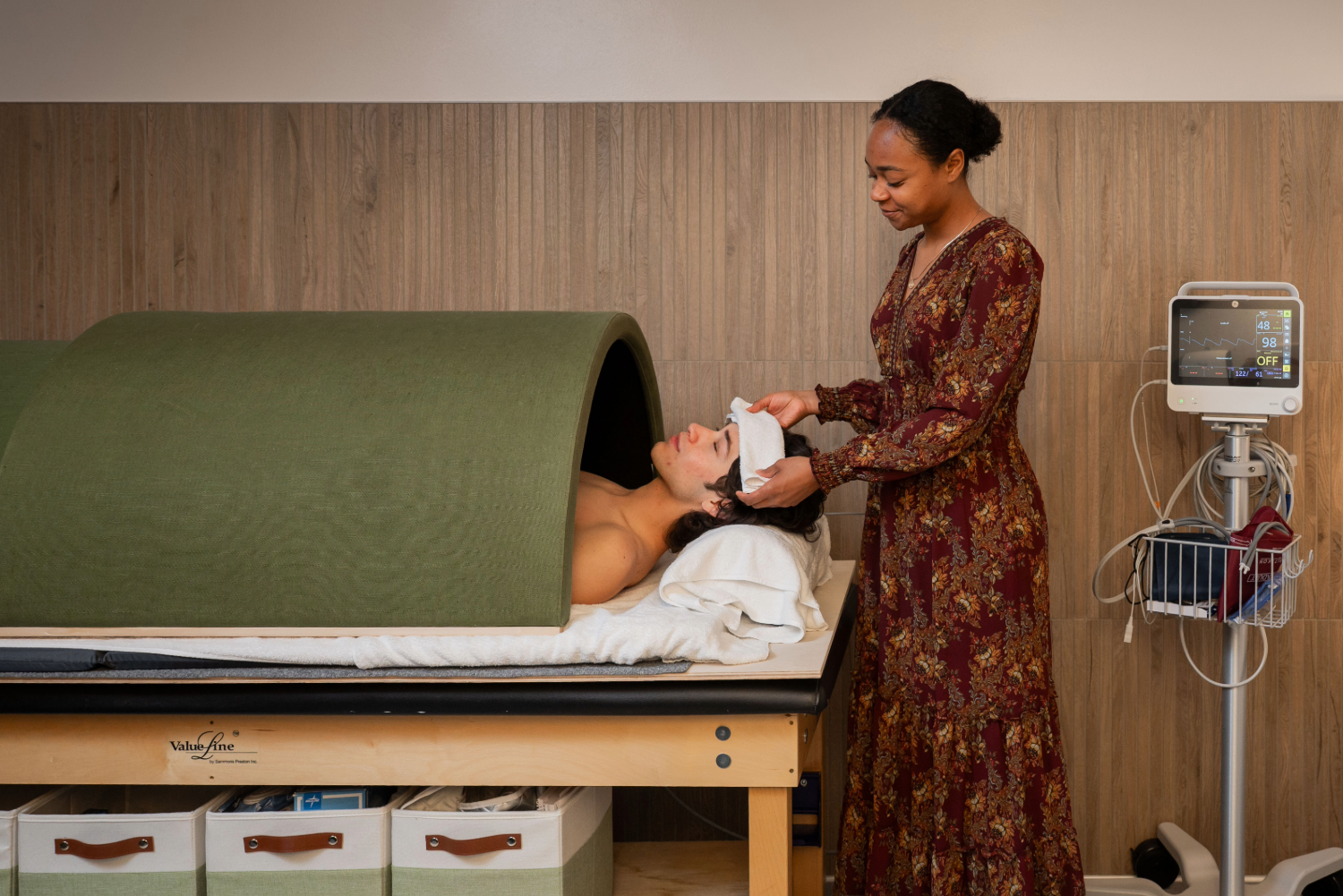
Hot, Cold and Mental Health: Inside Vail Health’s CHILL’D Research Study
Depression, a mental illness affecting more than 18% of American adults, has no blood marker or single biological cause. It looks and feels different in everyone because the brain is a complex organ, and there is no single way that depression develops. Like many mental health conditions, depression can be treated through medical, pharmaceutical and alternative approaches. One promising avenue under study at Vail Health’s Behavioral Health Innovation Center is contrast therapy — combining sauna and cold plunge treatments.
-
New!
More

What to Expect Before, During and After a Colonoscopy
If you've been putting off a colonoscopy, you're not alone. It's one of the most recommended — and most avoided — preventive screenings in medicine. But here's what most people don't realize until after their first one: the procedure itself is a non-event. You're asleep. You don't feel a thing. What people actually dread, and what they talk about afterward, is the prep. The good news is that even the prep is manageable, and the payoff is enormous. Colorectal cancer is one of the most preventable cancers when caught early. A colonoscopy doesn't just detect it; in many cases, it stops cancer before it starts.
-
New!
More

Navigating Men’s Sexual Health: Erectile Dysfunction and the Bigger Picture
For something so common — and treatable — erectile dysfunction (ED) is still surprisingly difficult to talk about. “The biggest misconception men have is that there’s a mechanical or physical problem with them, and that’s usually not the case,” explains Dr. Joseph Dall’Era, a urologist at Vail Health. In reality, ED is far more nuanced and manageable than people realize. Understanding what’s happening and knowing when to speak up can shift the experience.