



El coeficiente de amor: lo que un médico de la Vail salud aprendió sobre el lado más humano de la medicina en el campo rural de Camboya
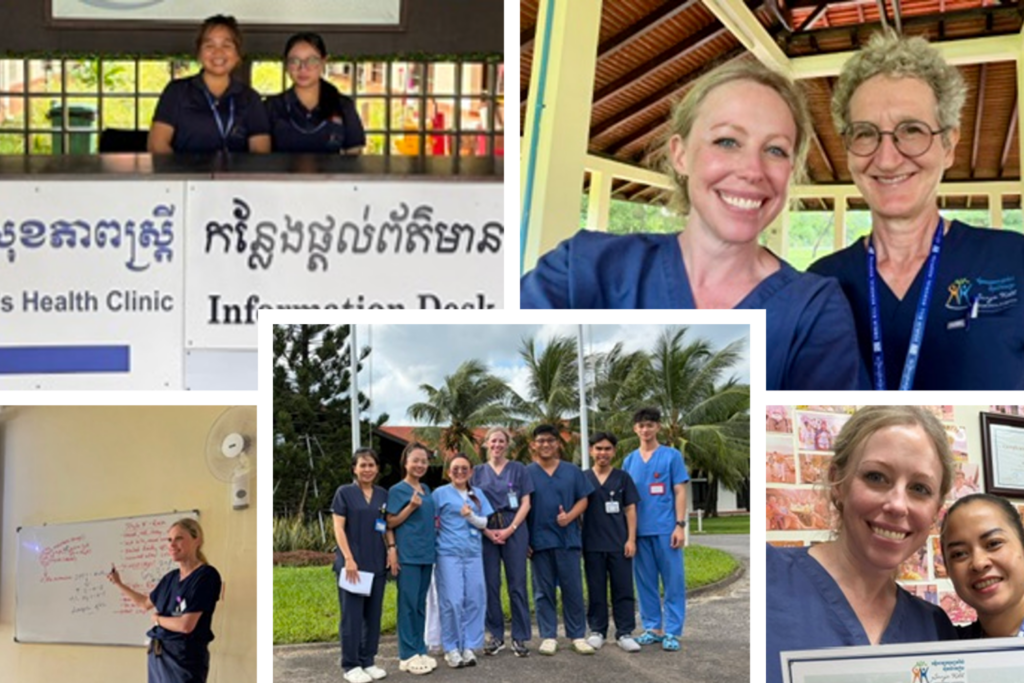
The tuk-tuk was the closest thing to air conditioning. Each morning during Cambodia’s rainy season, Dr. Regan Pyle climbed into the open-sided vehicle for the seven-kilometer ride from Kampot in southwest Cambodia to Sonja Kill Memorial Hospital. The breeze off the Kampong Bay River offered a brief reprieve from the heavy, humid air. Beyond the river, lush mountains rose towards the horizon. On the other side of the city, the sea. By the time she arrived, the heat had already settled in — and so had her sense of purpose.
Sonja Kill Memorial Hospital is a nonprofit hospital and training center founded in 2012 by Swiss surgeon Dr. Cornelia Haener. Its red-roofed, open-air buildings stretch across a sprawling campus, connected by long shaded walkways between grassy lawns. A staff of 280 provides care to patients who can pay while covering the cost of those who cannot, many of whom have traveled miles from rural villages for treatment.
The hospital offers emergency, maternity, inpatient and outpatient care, among other specialties. But specialists from around the world are part of an important mission: they come not just to treat patients, but to teach.
For Dr. Pyle, an allergy and immunology physician at Vail Health, the opportunity was personal. She had long wanted to volunteer in an underserved country, and Southeast Asia had always held a particular pull. She arrived ready to educate staff, but left with something she hadn’t expected to learn: a new way to name something she practiced throughout her career — the love quotient.
A Passport to Purpose
For Dr. Pyle, teaching is more than a professional skill. It’s part of who she is.
“I come from a line of educators — it’s in my blood to teach,” she says. “So this opportunity meant everything to me.”
Allergies and severe asthma are prevalent in Southeast Asia, where cooking over open fires, pollution and poor air quality can contribute to respiratory illness. Limited access to preventive care can also mean patients don’t seek treatment until their conditions worsen.
Allergy and immunology training doesn’t yet exist in Cambodia, giving Dr. Pyle valuable knowledge to share, and plenty to learn herself.
One More Tool
For the two weeks she volunteered at the hospital, Dr. Pyle’s days quickly fell into a rhythm. Mornings were spent making rounds through different departments. Lunch was shared with staff in the courtyard before she delivered afternoon lectures.
She worked closely with physicians to recognize and treat allergic and immunologic conditions in a setting where resources can be limited. Testing can be expensive and limited to what is available on site, so doctors must be thoughtful about what they order and often rely on clinical judgment.
“They’re trained to look for red flags. If it’s not urgent, they do what they can to make the patient comfortable,” she explains.
Her goal wasn’t to replace that approach, but to expand it by helping physicians consider a broader range of possibilities when evaluating a patient. “I hope that they feel more confident in considering allergic and immunologic conditions in their differential,” she says.
She wasn’t there to tell them what they were doing wrong. Instead, she was there to give them another practical tool for treating allergy and immunology in a resource-limited setting.
The Unexpected Lesson
The Love Quotient, or LQ, was something that Dr. Pyle picked up during one of the lectures. The hospital teaches it intentionally.
The concept describes a provider’s capacity for empathy, compassion and kindness towards themselves and others. For Dr. Pyle, the idea immediately resonated. “Love quotient was a term that was new to me, though the idea behind it was not,” she writes. “The premise is simple: if you want respect, earn it.”
It’s simple in theory, harder in practice.
With full waiting rooms, stacks of charts and the next patient waiting before the current conversation is finished, even compassionate physicians can find themselves racing the clock. But patient trust isn’t built on efficiency alone. It’s built into moments when a physician pauses long enough to listen, when a patient feels seen rather than processed.
At Sonja Kill Memorial Hospital, compassion is part of the culture. Even in a setting where every dollar and every hour of staff time matters, the hospital makes room for teaching physicians not only how to expand their clinical skills, but how to care for the patient beyond the diagnosis.
Sometimes, that compassion means making lifesaving care possible. When a young mother couldn’t afford heart valve surgery, the foundation covered the cost. The hospital doesn’t simply identify what patients need; it finds a way to make it happen.
Different Places, Same Purpose
In a place where medical resources are limited, some of the most powerful tools available cost nothing: empathy, listening and a willingness to understand what patients are experiencing.
The physical distance between Sonja Kill Memorial Hospital and Vail Health is enormous. The philosophy of care doesn’t have to be. At Vail Health, Relationship-Based Care is built on the belief that meaningful relationships are central to better care. Earning a patient’s trust isn’t an extra step added to medicine; it is the medicine.
For Dr. Pyle, Cambodia brought that philosophy into sharper focus. “Earning your patient’s trust is invaluable,” she says.
That can be challenging in a profession where physicians balance full schedules, demanding workloads and responsibilities outside the clinic. Which is why Vail Health is committed to caring for its providers, too
“Vail Health values the doctor’s individual wants and desires outside of the clinics and taking care of patients,” she says. “They value what’s important to us.” For Dr. Pyle, that meant a journey to educate and elevate health in a rural community and return home with a renewed appreciation for what it means to care.
The Love Quotient
Dr. Pyle went to Cambodia to share what she knew. But somewhere between the hospital rounds and the humidity, she was reminded of something just as important: the best medicine isn’t only about what you know. It’s about how you make people feel.
Vail Health and Sonja Kill Memorial Hospital may be on other sides of the world with different cultures and very different resources. But their shared lesson is universal: care starts with people.
For Dr. Pyle, volunteering in Cambodia wasn’t simply an opportunity to give back. It was a reminder that compassion is a clinical skill, too. “It’s a gift to represent Vail Health in rural Cambodia to make a positive impact on their health system,” she says.
Sometimes, making an impact starts with knowledge. Sometimes, it starts with a listening ear. And sometimes, it starts with an open heart.
Training the Heart of the Hospital
Dr. Pyle was not the only Vail Health voice in Kampot. Ben Miller has also traveled to Sonja Kill Memorial Hospital to lead compassionate care training for the entire staff, an invitation that followed an introduction from Dr. Pyle to the hospital’s CEO, Dr. Cornelia Haener. His years of leadership training and community work in Southeast Asia shaped the approach, as did his role at Vail Health, where he supports conversations about self-care, teamwork and how providers treat the person in front of them.
Humility guided the work. “You can’t walk into Cambodia and assume that because something works in the U.S., it will work there,” Miller says. Rather than correct what the staff already did well, he focused on encouraging the care already present and offering practical tools suited to their setting.
Much of the training centered on the idea that compassion begins with the caregiver. Miller says staff experience and patient experience cannot be separated, because employees who feel unseen or unsupported have a harder time being present with patients. The hospital also treats a large expat community, which gave staff a real-world way to practice empathy. “If someone is angry, what fear might be underneath that anger?” he asks. Conversations about end-of-life care carried the same theme, as Miller encouraged staff to lean in when medicine can no longer change the outcome.
His work has continued since the trip. As the hospital responds to new national accreditation regulations and aims to become a model for rural hospitals in Cambodia, Miller is helping develop a hospital-wide quality and safety program, an annual employee engagement survey and a staffing plan that meets current requirements. He points to the hospital’s on-site daycare, housing and free medical care for employees and their extended families as proof of its philosophy: staff who are cared for care well for others.
“Building people up is always the way,” Miller says.